New software improves exoplanet imaging on Webb telescope
Researchers developed a tool that refines telescope models to reduce noise from hardware variations, enabling clearer images of distant worlds.
By Jisoo Kim ·
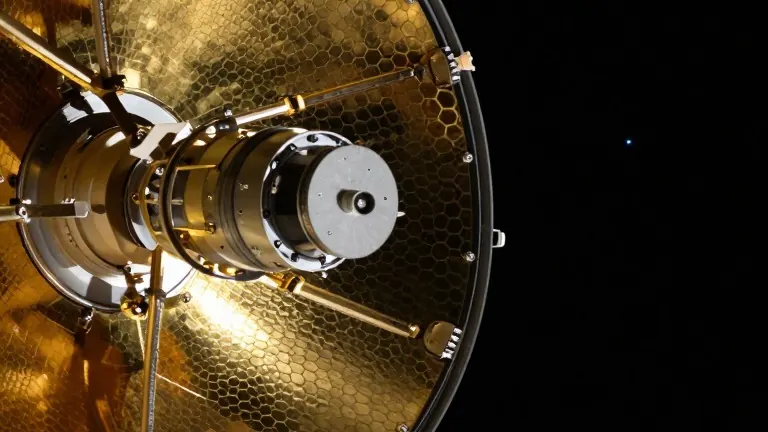
The James Webb Space Telescope has generated a massive catalog of exoplanets, prompting scientists to seek better methods for studying their physical conditions. Direct imaging and atmospheric analysis remain difficult because host stars outshine their planets by a large margin. Existing hardware, such as coronagraphs, blocks much of this starlight but cannot eliminate all interference.
A new software package addresses these limitations by optimizing physical models of the telescope. The tool accounts for subtle variations in the instrument's configuration and pointing accuracy between observations. By refining these mathematical representations, the software reduces noise in the final data, producing clearer images of exoplanets.
The development centers on the point spread function, which describes how a telescope distorts a single point of light. Ideally, a point source appears sharp, but hardware imperfections and pointing drift cause the image to blur and spread. Understanding this distortion is essential for separating a planet's faint light from the glare of its star.
Scientists typically determine the point spread function in two ways. The first method involves imaging a known target to derive the function mathematically. While effective for reducing noise, this approach has limits because telescope hardware behavior changes over time. The function also varies depending on the specific wavelengths being captured.
The second method attempts to model the hardware's behavior directly to derive the function. This route is computationally difficult because modern telescopes are complex instruments with numerous interacting factors. Even with full engineering schematics, many parameters require precise tuning to make the model tractable. The new software improves this process by better optimizing the physical model.
The researchers note that noise from pointing and configuration shifts remains a primary obstacle to high-contrast imaging. The new tool allows for a more accurate representation of these dynamic factors. This advancement supports the next phase of exoplanet research, which involves inferring surface conditions and atmospheric composition from direct observations.