University of Maryland Team Deploys Robots to Map Oyster Recovery in Chesapeake Bay
Engineers are using autonomous underwater vehicles to solve visibility problems that have hindered oyster farmers and conservationists.
By Tristan Parker ·
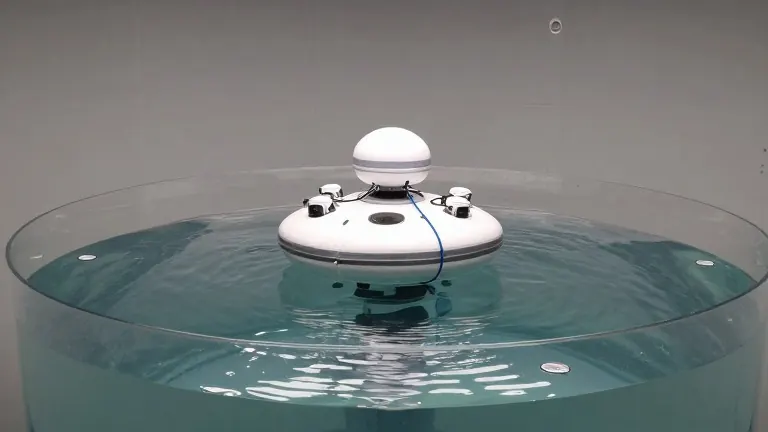
A research team at the University of Maryland is testing autonomous underwater robots to help oyster farmers locate and harvest their crops in the murky waters of the Chesapeake Bay. The project addresses a core difficulty for aquaculture in the region: low visibility that makes it hard to determine where young oysters have settled and when adults are ready for harvest.
Miao Yu, a mechanical engineer at the university, leads the initiative. Her team operates inside the campus Neutral Buoyancy Research Facility, a large cylindrical tank used for testing. During a recent demonstration, graduate student Michael Xu piloted a custom-built raft-like robot called Oysterbot using a joystick. The device is equipped with a sonar unit mounted below its pontoons to scan the water column.
Xu explained that the team uses the robot to perform large-range scans to create a general map of the seabed. For closer inspection, they deploy a smaller, commercially available robot named the BlueROV, which provides a live video feed. The two units work in tandem to document the underwater environment.
The team processes the collected data using artificial intelligence algorithms. These tools analyze the visual and sonar data to determine oyster presence, estimate population density, assess mortality rates, and measure size. Yu stated that the long-term goal is to convert raw sonar images into actionable oyster information maps for commercial farmers.
Current oyster populations in the Chesapeake Bay remain a fraction of their historic levels, according to Elizabeth North, a fisheries oceanographer at the University of Maryland Center for Environmental Science. North noted that while wild oysters have seen a partial comeback due to better management and restoration investments, the recovery is still modest. Ryan Carnegie, a biologist at the Virginia Institute of Marine Science, added that farming has expanded in recent years despite environmental challenges.
The technology aims to replace guesswork with precision. Yu noted that farmers currently struggle with two main tasks: finding suitable hard substrates for larvae to attach to and identifying ready adults for harvest. Without clear visual data, harvesting often involves inefficient dredging that can damage the seabed or disturb oysters not yet mature.
John Consoli, a professional photographer at the University of Maryland, was introduced to the oyster research during a campus shoot. He has since become a local conservation advocate on Kent Island, Maryland. Consoli manages a network of over 80 neighbors who grow oysters on their private piers. In August, he collaborated with Libbey's Coastal Kitchen to install one million baby oysters around the restaurant's dock pilings. The team used a smaller off-the-shelf robot to assist in monitoring the site.
Source: WBAA · original report published
More Tech · Indianapolis news · Report a business · Got a Story?