Russia and Iran finalize $25 billion nuclear plant deal
The Sirik facility in Hormozgan Province will add 5 gigawatts of capacity, expanding Moscow's footprint in Tehran's energy sector.
By Tristan Parker ·
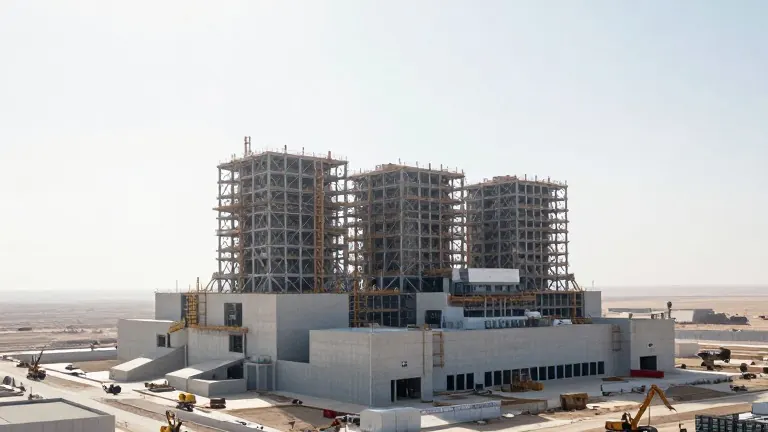
Russia and Iran have signed a $25 billion contract to build a new nuclear power plant in the southern Hormozgan Province.
The Sirik facility, located near the Strait of Hormuz, is designed to generate approximately 5 gigawatts of electricity. This capacity exceeds the projected output of the existing Bushehr complex, which will produce less than 3 gigawatts once fully operational. The agreement was formalized in September 2025.
The deal represents a major expansion of the nuclear partnership between the two states. Russia’s state nuclear corporation, Rosatom, has been the primary contractor for Iran’s nuclear sector since the 1990s. The initial contract for the Bushehr plant’s first reactor was signed in 1995, though that unit did not begin full commercial power generation until 2013. Construction on two additional units at Bushehr is currently underway. Rosatom reports that the second unit is more than 60 percent complete and targets an operational start in 2029. Work on a third unit is also progressing.
The physical presence of Russian staff at these sites has fluctuated in response to regional conflict. Following the start of the US-Iran war in February, Rosatom evacuated the majority of its personnel from Iran. By October 11, the company reported that 135 engineering and technical specialists had returned to the Bushehr site to resume operations.
The financial and strategic implications of the partnership are uneven. Nikita Smagin, an analyst at the Carnegie Endowment for International Peace, wrote in November 2025 that the balance of the relationship is shifting in Russia’s favor. He noted that Iran is in dire need of investment and that Russia remains one of the few available sources for nuclear technology and fuel supplies. Dmitry Kovchegin and Arkady Mil-Man of Israel’s Institute for National Security Studies described Moscow’s approach as a calculated balancing strategy. They observed that Russia offers limited assistance that does not alter the military balance of power while seeking to improve its diplomatic position with the United States.
The expansion of nuclear infrastructure coincides with reduced visibility from international inspectors. The International Atomic Energy Agency (IAEA) published a report on June 4 detailing its activities during a specific reporting period. The agency stated that it conducted an inspection at Bushehr from June 1 to June 3. However, it was unable to inspect other declared nuclear sites during that timeframe. These sites include four uranium enrichment facilities.
The IAEA stated it could not verify the status of nuclear material at the uninspected sites. The agency also could not confirm whether Iran had suspended uranium enrichment, reprocessing of spent reactor fuel, or heavy-water-related activities. These processes are regulated by UN Security Council and IAEA resolutions. The report describes the situation during the specified period and does not provide a real-time assessment of current access.
The Sirik deal locks in a long-term dependency on Russian technology and fuel. The Arms Control Association, in a June 2025 analysis, noted that Iran’s enrichment of uranium to 60 percent has no civil justification. The group stated this level of enrichment positions Iran to quickly produce weapons-grade material, which typically requires enrichment to 90 percent.
Source: RFE/RL
More Business · Business Complaints · Report a business · Got a Story?