Vance Tests 2028 Messaging With Midterm Stump Speeches
Vice President JD Vance is refining his populist appeal in rallies across Texas, Michigan, and the South, signaling how he might pitch a future presidential bid.
By Jisoo Kim ·
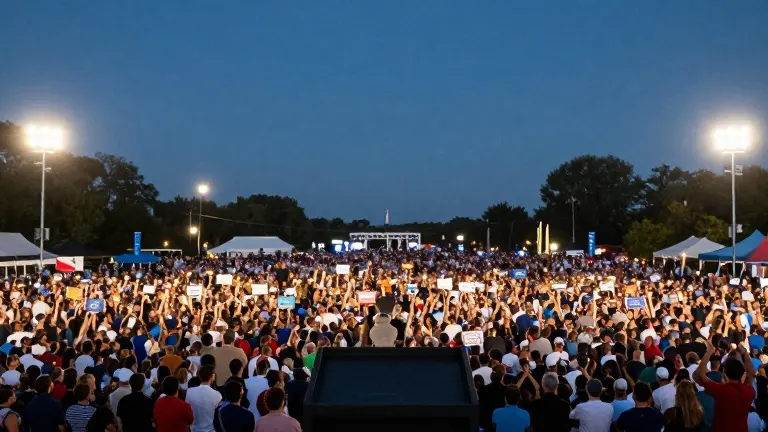
Vice President JD Vance is using his pre-midterm rally schedule to test the waters for a potential 2028 presidential campaign. His speeches, delivered in states including Texas, Michigan, and North Carolina, blend nostalgic storytelling with sharp attacks on Democratic opponents. The strategy offers a preview of his political brand as the 2028 cycle approaches.
In Weatherford, Texas, Vance targeted Democratic Senate candidate James Talarico. Vance told the crowd that Talarico had to grapple with his masculinity in addition to his whiteness. He added that there was not a whole lot to grapple with, prompting cheers from the audience. This style of direct, personal attack distinguishes his delivery from President Donald Trump’s more comedic approach.
Vance’s rhetoric centers on a vision of America he describes as lost to distant political elites. In Howell, Michigan, he recalled his childhood football teams being sponsored by local small businesses. He noted that many of those businesses no longer exist. He blamed politicians in a faraway place who did not care about states like Michigan or Ohio, arguing that local communities paid the consequences.
He frames his populist politics as a way to restore that lost sense of pride and unity. In North Carolina, he invoked the feeling of fellowship Americans experienced after the September 11, 2001 attacks. He also highlighted racial harmony in his youth, describing how children of working-class Black and white families played football together without worrying about skin color or privilege. This narrative packages the anti-woke message in a more traditional and eloquent style.
Vance is also experimenting with a more casual tone. In Texas, he told the crowd he was sweating at the podium. He occasionally uses informal language, moving away from the polished politician image to connect with voters. This approach contrasts with the bombast and unfiltered anger that defined Trump’s political persona for over a decade.
A key challenge for Vance is promoting Republican candidates while the sitting president remains unpopular. This difficulty is most evident in states where federal policies have caused economic pain. Vance has avoided directly mentioning the Iran War in his stump speeches, even though the conflict drove up gas and diesel prices. Instead, he characterizes high fuel costs as a recurring result of global geopolitics.
In Montana, Vance compared current gas prices to spikes seen in 1979, 2001, 2007, and 2022. He argued that prices skyrocket whenever a tin pot dictator throws a tantrum. Similarly, he acknowledged the high price of beef but attributed the issue to consolidation among meatpackers. This framing allows him to address consumer concerns without directly criticizing Trump’s policies that have angered beef producers.
Vance has also leveraged his role as head of the presidential anti-fraud task force. He uses these appearances to discuss his personal background and the social safety net. In Cincinnati, he told a crowd that his first job was as a cashier at a grocery store about twenty miles away. He noted that many of his family members benefited from federal food programs.
His memoir about growing up in poor, rural southern Ohio provides him with political tools that Trump lacks. Vance can speak personally about military service and economic hardship. However, the core challenge for any 2028 Republican candidate is determining what can replace Trump’s singular performance in the hearts of GOP voters. Vance’s current campaign trail serves as the primary experiment for that question.
Source: KPBS