San Antonio Student: 3D-Printed Wheelchair Costs a Fraction of Standard Price
Gracie Martinez printed 18 components for a toddler mobility trainer now in use at a San Antonio therapy center, demonstrating a low-cost alternative to expensive adaptive equipment.
By Paul Davidson ·
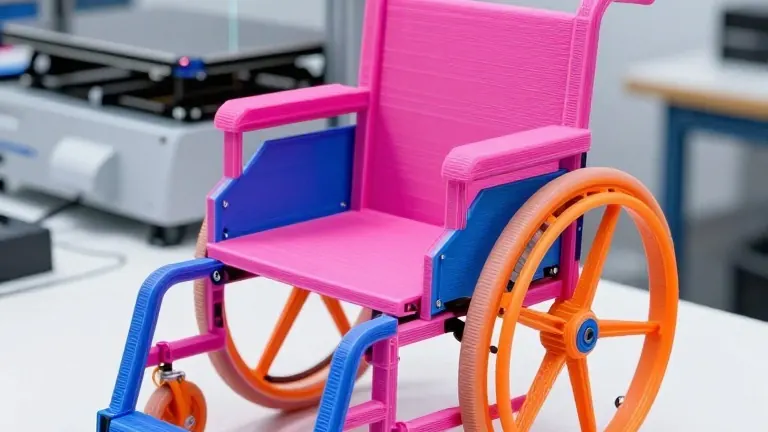
18 individual pieces were 3D printed to assemble the Toddler Mobility Trainer, a small wheelchair designed for children with disabilities. Gracie Martinez, a student at the Texas Military Institute Episcopal in San Antonio, built the device to help a young patient learn to operate a wheelchair before transitioning to a larger model. The project addresses a common barrier for families who find adaptive equipment difficult to acquire and often prohibitively expensive.
The idea originated after Martinez and her mother viewed an Instagram account from MakeGood, a New Orleans-based nonprofit that customizes free 3D-assistive devices. Martinez discussed the concept with Omar Valdez, the director of innovation and design at her school. Valdez agreed to support the project and provided Martinez with 3D printers for her home so she could build her own laboratory. This arrangement allowed her to work on the design without commuting back and forth to the school.
"I asked him, ‘Would this be possible to do?’ And he was like, ‘Yeah, for sure! TEAMability is actually looking for something similar to this,’” Martinez said. TEAMability, an organization that supports individuals with complex disabilities using physical, occupational, and speech therapy, is housed at Morgan’s Multi-Assistance Center in San Antonio.
Martinez downloaded design files from the MakeGood website and printed the 18 separate components for the chair. She described the process as a large puzzle. The chair features removable, modular parts that can be interchanged with different colored components. Valdez noted that the 3D printing process allows for easy customization. "We have the ability to change the colors. To my knowledge, I haven't seen too many wheelchairs.. I think I've seen maybe a pink one, especially for younger children," Valdez said. "But now with just a few pushes of a button, we can print a Ninja Turtle wheelchair or a princess wheelchair."
The completed wheelchair is now at TEAMability. Brooke Kearney, the center’s CEO, demonstrated the device and highlighted the variety of plastic filaments used. "So, what's really cool is in developing areas, rural areas, anybody, you or I, could purchase a 3D printer, print these parts, and then put the pieces together, which makes it really easy to ship and move," Kearney said. She pointed out that the different plastics offer varied textures, with some parts being harder and others squishier to the touch.
The partnership has inspired the organization to create additional adaptive devices. Victor Gardea, a clinical specialist at TEAMability, is currently making a waffle-shaped fidget toy for one of the therapists. Cecilia Najera, a professor in the Department of Occupational Therapy at UT Health San Antonio, said her students are also using TMI’s 3D printers. One student is creating an adaptable bird feeder for a 79-year-old patient who injured her rotator cuff and cannot lift her arm higher than 60 degrees. The feeder includes a latch that allows the patient to open it with one hand.
Another group of students identified a lack of trays in wheelchair sections at movie theaters. They are working with TMI to construct an adaptable tray that would allow wheelchair users to keep food and drinks within reach during a film. Najera said the project shows how 3D printing allows for specific, personalized solutions for daily activities.
Martinez plans to study industrial engineering in college to expand her work from 3D printing to larger scale projects. She cited conversations at TEAMability where patients described the world as not truly accessible despite common claims. "Like, seeing it through y'all's perspective, okay, I see now. This is a change that needs to be made," Martinez said.